
What is the excess of the accommodation of the crystalline?
How does it manifest itself and from what causes does it appear?
Excess of the accommodation of the crystalline refers to the fatigue of the muscles that coordinate the crystalline, called the ciliary muscles or the ciliary processes. They act on the crystalline trees by changing their shape according to the distance we look at, helping us to see well at different distances (primary function of the crystalline). Without this accommodation of the crystalline, if they remain in the “relaxed” position, you will see well at distance but you will not see well close.
The excess of accommodation comes when we work for a longer period in the near environment, without taking breaks to relaxx the ciliary muscles.
In the first phase we will notice that after a long period of work (at least an hour but depending on age) we will have a foggy view in the first seconds when we look at a distance. This is due to the fatigue of the ciliary muscles, that no longer have the power to elongate the crystalline (to see well at distance), in a fraction of a second, how long it takes to move the gaze from the close environment to distance.
This excess, repeated it daily, leads over time to a constant symptomatology, and in some cases, especially in children, can lead to the development of myopia. – “Online School” – We need a blakboard to exercices our cilliary muscles, our brain, and get rid of myopia !
Why does the excess of accommodation manifest itself differently depending on the age?
In the table of crystalline accommodation, you will notice a decrease in the amplitude of accommodation with age, so if at 9 years you have an accommodation of about 20 diopters, at 45 years you will have only 3-4 diopters, hence the different manifestation of excess depending on age.
So, an adult who makes excesses of accommodation (works in the near eviroment without breaks made in time) will bear the related symptomatology (headaches, dizziness, etc. or increase in dioptric values, if he already has a myopia) and a young person, in addition to symptomatology, due to the high flexibility of the crystalline, can reach myopia.
Attention!
Some dioptron type devices give higher negative values in the excesses of accommodation compared to the real diopter (which in some cases is 0.00 even if the dioptron reads -5.00 dpt., attention to the age / the accommodation power of the crystalline), and in some people’s cases, even cylindrical values that are not related to reality (the crystalline is deformed and visual acuity is low – a new chapter on the evolution of the crystalline and eyeballs in the next generations).
An adult with excess of accommodation:
- It has a corrected myopia – the dioptron values will be higher than the real ones.
- It has a corrected hyperopia – dioptron values will be lower than the real ones, even negative values, if hyperopia is small.
- It has no problems with remote vision – the dioptron values will be negative until about 50-60 years if the accommodative excess is high.
Myopia grows from excess accommodation (at any age up to about 60-65 years in certain cases) and with physiological growth in children(up to 22-23 years), regardless of whether it arises from excess or genetically inherited!
So, if myopia grows slowly (by 0.25 – 0.50 dpt./year) in an adult over 25 years of age, this is not a galloping myopia but only an increase in myopia from excess of crystalline accommodation.
Eye activity in the close work environment and the concept of break 20-20-20
Close work environment – any eye activity between 20cm and 1.2m (desktop, laptop, mobile, tablet, book…)
Optimum comfort in the near-working environment
- Why do I have to take breaks, when I work up-close?
- How long does it take and what is a break?
- At what time frame do I have to take these breaks?
- At what distance should I look from the display?
In the US there is the 20-20-20 concept, it teaches those who work for a long time in a close environment to take a break from work every 20 minutes and look at over 20 feet (about 6m) for 20 seconds. This concept arises due to the understanding of the accommodation of the crystalline and its role in the visual act.
The clear view at different distances is supported by the accommodation of the crystalline as follows:
– If you look at objects at distances of over 6m, the crystalline trees are elongated, the ciliary muscles that coordinate them are totally relaxed, and the pupils of large size (depending on the UV)
– When you look in the close work environment (20cm – 1.2m) the crystalline is accommodated (bulging), the cilliary muscles are in tension and the pupils are small size.
 Farsight Nearsight
Knowing these things we can deduce that at a certain time interval we are forced to relax the cilliary muscles (like any other muscle in the body), otherwise after a long effort they will enter into muscle spasm, and in the first seconds in which we try to look at the distance the image will NOT be clear.
This is a faulty accommodation of the crystalline trees due to the long effort to which the cilliary muscles were subjected. At the moment when it is repeated daily, the person in question may have headaches, dizziness or other disturbing symptoms and over time can reach myopia (mostly true until around the age of 30) which can increase with the support of the same method of working without breaks made on time.
 The biconvex shape of the lens creates positive values inside the eyeball and if it is too long held in tension it will tend to remain slightly accommodated (bulging) when we look at the distance. So, we will have a plus inside the eyeball that corrects with minus outside it and will create that myopia that we were talking about above.
The break means to move the gaze from the close work environment to the farthest corner of the room or at as far distance as possible (over 6m) for 20 seconds (or to close the eyes the same period), at a time interval set depending on the state of eye fatigue of each person, between 10 and 45 minutes approximately.
In the morning, when we start working in the close environment, the cilliary muscles have a good tone and sufficient power to support the accommodated crystalline to the maximum (with the highest possible dioptric power) for a clear and relaxed vision for a while.
After about 45 minutes, the ciliary muscles begin to get tired and gradually decrease the tension in which they hold the crystalline, as they lose the power of accommodation. At this time, it is necessary to relax the ciliary muscles -this can be done by moving the gaze to as far a distance as possible, for minimum 20 seconds, or closing the eyes for the same period.
During a working day, it is possible that in the morning we take these breaks at a longer interval of time, 40-45 minutes (if we slept well the previous night), at noon somewhat more often, 20-25 minutes, and in the evening at 10-15 minutes, if we continue the accommodation of the crystalline.
To find the optimal distance from the display we can use two methods
– We display a text with characters as small but visible as possible, we approach and move away from the text until it becomes indecipherable. We will notice a minimum and a maximum distance at which we can read the text, the average of these distances being the point at which the eyes perfectly fix the text being viewed, that is the optimal distance.
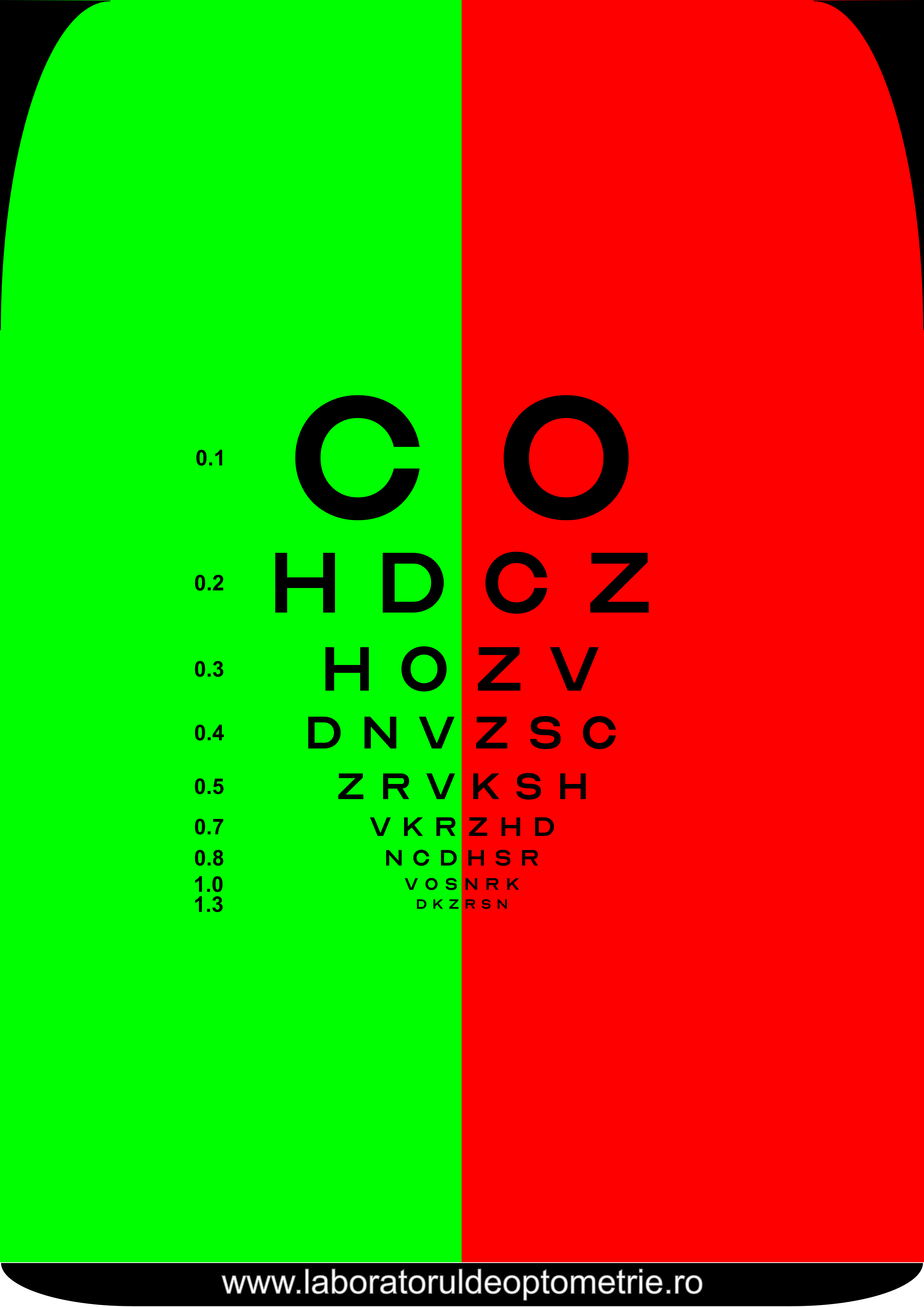
– We do the same as in the first method, with one difference: that the text displayed is on a red and green background, and the optimal distance is the distance at which we see the text as clearly on both colors(best with near glasses, after 45 years old). R/G test
The evolution of the accommodation of the crystalline and its influence during life
The crystalline is meant to help us see well at different distances, as they function as an “auto-focus” in the camera. But in addition to this primary function, they also have the role of correcting certain dioptric problems, being limited by the power of accommodation (age), by the dioptric value and the dioptric sign.
These functions are performed with the help of accommodation of crystalline. We can imagine the lens as a biconvex organic lens, which due to its shape has the ability to change its dioptric value from 0 to about +20.00 diopters.
On average, the evolution of the accommodation of the crystalline is held as follows:

Since birth, nature has endowed us with a powerful lens that increases its ability to accommodate until around the age of five, and after, it decreases continuously, all its life.
So, at an early age, when the eyeballs are not fully developed, they are smaller, hyperopic and need positive values, nature helps us with a lens that can largely compensate for the lack of development.
And yet this accommodation of the crystalline influences further.
Let’s take the case of a 10-year-old who has an uncorrected hyperopia between +0.75 and +1.25 dpt.
Its crystalline lens accommodates about +19.00 dpt., and in this case, the need for glasses does not exist (nor the appropriate symptomatology), since the power of the crystalline is much higher than their dioptric need to form a clear image. The child’s crystalline compensates almost effortlessly throughout the day for dioptric need.
But the same child reached the age of 18-20 years (at this age the crystalline accommodating 10 dpt.) will gradually begin to go through a mild symptomatology at first, but progressively it will increase and probably repeated headaches or states of eye discomfort will send the patient to a specialist consultation.
Every time the eyeballs do not work perfectly (the image is not formed on the retina, due to a dioptric need or an improper optical correction), the crystalline will continuously accommodate, by trying to compensate for the lack or the dioptric surplus (secondary function of the crystalline). This is the main cause of the appearance of eye discomfort (in addition to the eye effort in the close environment without breaks) and the various symptomatic states resulting from these causes: dizziness, headaches, dry eye sensation and itching, reddening of the eyeball (hyperemia), etc.
Due to the biconvex form, by accommodation, crystalline trees can create different positive dioptric values, so they can correct to some extent a hypermetrope (person with positive dioptric needs), therefore a small hyperopia (up to +3.00 diopters) is relatively asymptomatic until the age of 6-9 years and hardly noticed by parents.
In a 10-year-old child, with a myopia between -1.00 and -0.50 diopters, the crystalline cannot help, he sees at a distance only 60-80% of normal, and in this case, the symptomatology appears much faster, primarily by weakening the visual acuity. In this case, the child “squeezes out of his eyes”, shrinking the palpebral slit and the shape of the cornea for a clearer picture at a distance.
Attention! It is not just the protection filters (PC filters) of the lenses or the “drops” of a certain kind that help us when we spend a lot of time at the computer, mobile or tablet, but our conduct in this environment! These filters only protect the eyeballs when subjected to certain radiation, and the solutions can mask the symptoms! Breaks in the close environment are the ones that get rid of the symptomatology and possibly the appearance of a myopia (or the increase in the values of an existing myopia), not the filters or ophthalmic solutions!
